
Synapse Audio The Legend HZ v2.0.2.R1 for macOS
Description
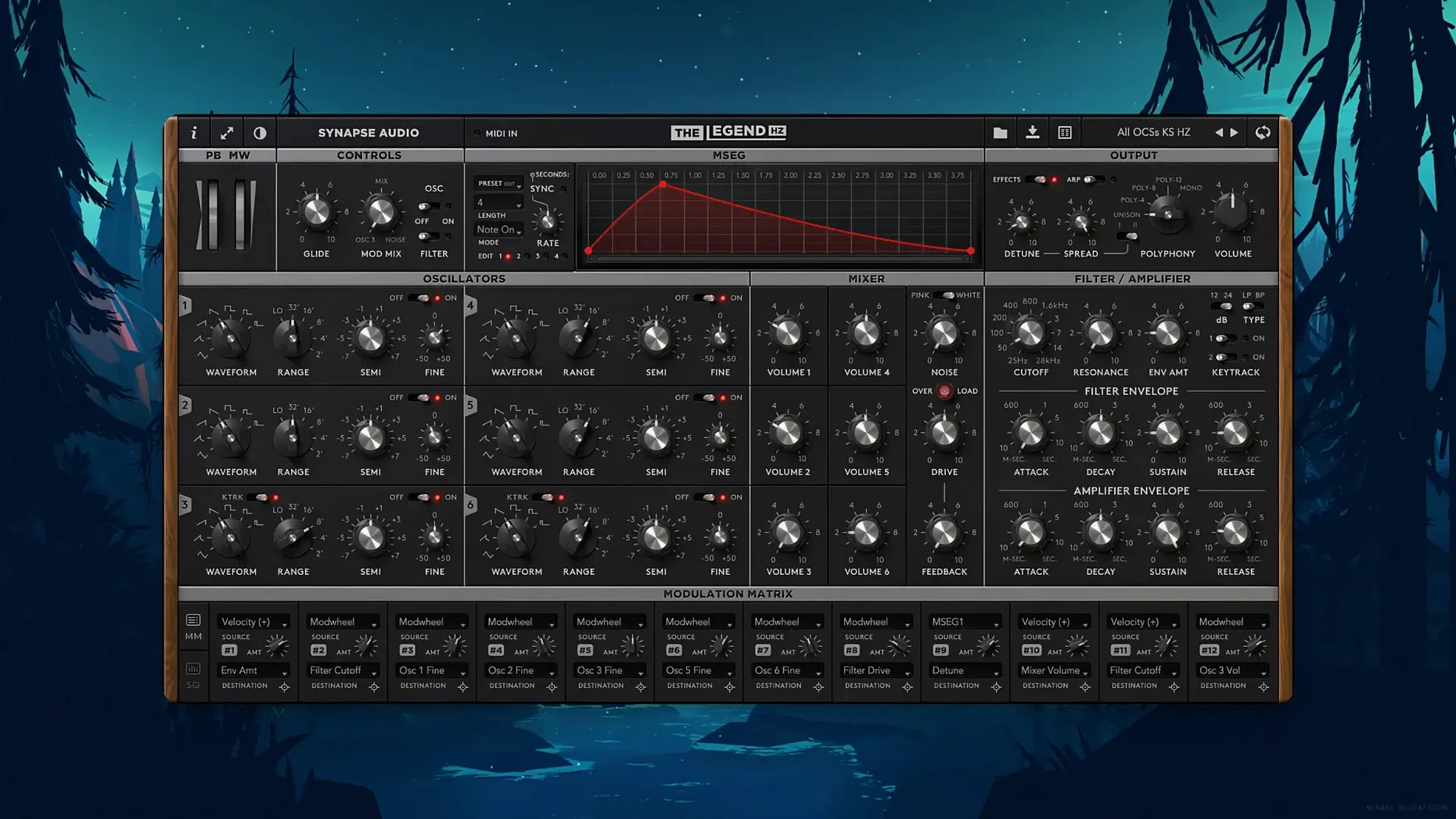
You load it on a bass channel that felt right yesterday but sounds thin today. The first thing you reach for is the filter cutoff — knock it down to around 400 Hz and the low end tightens up without any external EQ. That is the core of The Legend HZ: it does what a good hardware synth does, but with more control under the bonnet.
- Pick one of the six VA oscillators. Detune two against each other and engage unison mode. The stereo spread is immediate — no chorus needed.
- Set the arpeggiator to a simple sixteenth-note pattern. The sequencer locks to host tempo cleanly, so you can audition filter moves while it runs.
- Open the back panel. The new paragraphic equalizer lets you carve out mud around 250 Hz or add air above 8 kHz before the signal hits the compressor saturation stage. Drive the compressor gently and the sound gains presence without losing its analogue roundness.
What sets this apart from its predecessor is how much shaping happens after the oscillators. The back-panel EQ and compressor saturation turn a good patch into something that sits in a mix with less processor drain than stacking separate plugins. MTS-ESP microtuning support means it behaves properly with non-Western scales too. Projects that contained the original Legend still open — both versions run side by side, so old sessions stay intact while you build new sounds with the extra features.
A back-panel EQ that replaced extra plugins
The back-panel paragraphic EQ arrived with version 2.1. Before that, you had to patch in a separate EQ plugin whenever a preset needed surgical shaping. Now you pull up the back panel, click a band, and drag. The display shows exactly which frequencies you are cutting or boosting — no guesswork, no extra plugin windows cluttering the screen.
Compressor saturation appeared in the same update. It is not a full dynamics processor. Crank the drive and the signal thickens with a soft-clip character that mimics pushing a hardware desk channel. Dial it back and it adds a barely-there glue that helps patches sit together in a busy arrangement. The effect is subtle enough that you can leave it engaged on most sounds without the low end turning to mud.
MTS-ESP microtuning support matters if you work outside equal temperament. Load a scala tuning file or connect to an MTS-ESP master plugin, and all six oscillators follow the scale. Arabic maqam, Turkish makam, Wendy Carlos-style harmonic scales — it just works. The 50 new Kevin Schroeder presets lean into this, with several patches built around microtonal intervals that were impossible to program accurately in the previous version.
Cue-ready pads and bass for scoring deadlines
Film composers and media scoring people tend to reach for it first. The Hans Zimmer connection is not just branding — the factory presets fit cinematic workflows immediately. Big, evolving pads that fill a cue without piling on layers. Bass patches with enough weight to underscore a tense scene but enough definition that the dialogue still cuts through.
Sound designers who build patches from scratch appreciate the 914 Fixed Filter Bank. It is a separate module modelled on a classic hardware EQ, and it does things a normal parametric EQ cannot — ringy, resonant band-pass shapes that turn a simple saw wave into something metallic and strange. Combine it with the sequencer and you can create rhythmic filter sweeps that change character as you shift the band gains.
Keyboard players who want a Minimoog-style instrument with modern reliability get a straightforward panel. Knobs are large, labelled clearly, and respond to MIDI CC without fuss. MPE support means a Roli Seaboard or LinnStrument will bend pitch per note without glitching — something the original Legend cannot do.
Why original Legend patches load right in
Against the original Legend, the HZ edition adds the fixed filter bank, double the polyphony at 12 voices, the arpeggiator/sequencer, and now the EQ and compressor saturation. If you already own patches for the original, they load here unchanged. The two plugins coexist in the same project without conflict — the HZ version opens as a separate instrument, so old sessions do not break.
U-he Diva shares the analogue modelling approach but takes more CPU and focuses on modular-style flexibility. Diva lets you swap oscillator and filter models; The Legend HZ commits to one sound and polishes it until the CPU meter barely twitches. On an older Intel Mac, that difference becomes obvious around the sixth or seventh instance.
Arturia Mini V goes deeper into Minimoog territory with more modulation routing and built-in effects. It also ships with a larger preset library. The Legend HZ counters with the 914 filter bank, MPE support, and a leaner interface that does not scroll. If you want a synth that loads fast and sounds right within three knob turns, The Legend HZ wins on speed. If you need three LFOs and a modulation matrix, Mini V fits better.
Softube Model 72 sounds excellent but offers no built-in sequencer and no fixed filter bank. Its strength is component-level modelling of a specific vintage unit. The Legend HZ takes the spirit of that architecture and expands it into something more versatile for daily production work — fewer spot-on emulation claims, more practical tools like the arpeggiator and back-panel processing.
What’s new
Adds a paragraphic equalizer on the back panel.
Adds compressor saturation.
Adds MTS-ESP microtuning support.
Adds 50 factory presets by Kevin Schroeder.
Requirements
- macOS 10.14 or later
- Intel 64-bit or Apple Silicon Mac
- English interface
FAQ
Is The Legend HZ compatible with older sessions?
Yes. Projects containing The Legend open the original instrument, so both versions can run in parallel without breaking existing work.
Comments 0
Sign in or create an account to leave a comment.
No comments yet…
If you’ve installed it, say how it went. Mention your Mac and macOS version — it helps the next person more than you’d think.
More in VST Plugins
All in VST Plugins-
 Synchro Arts VocAlign 6 Pro
6.1.30
Apple Silicon
-
 T-RackS
6.3.2
Apple Silicon
-
 Supertone Air
1.0.1
Apple Silicon
-
 Superior Drummer
3.4.4
Apple Silicon
-
 Steinberg SpectraLayers Pro
13.0.20-All-in-One
Apple Silicon
-
 Spire
1.5.19
Apple Silicon
-
 Tone Empire EDYN
1.0.2
Apple Silicon
-
 Sonic Academy KICK
1.1.8
Apple Silicon