

Slate Digital Fresh Air for macOS
Description
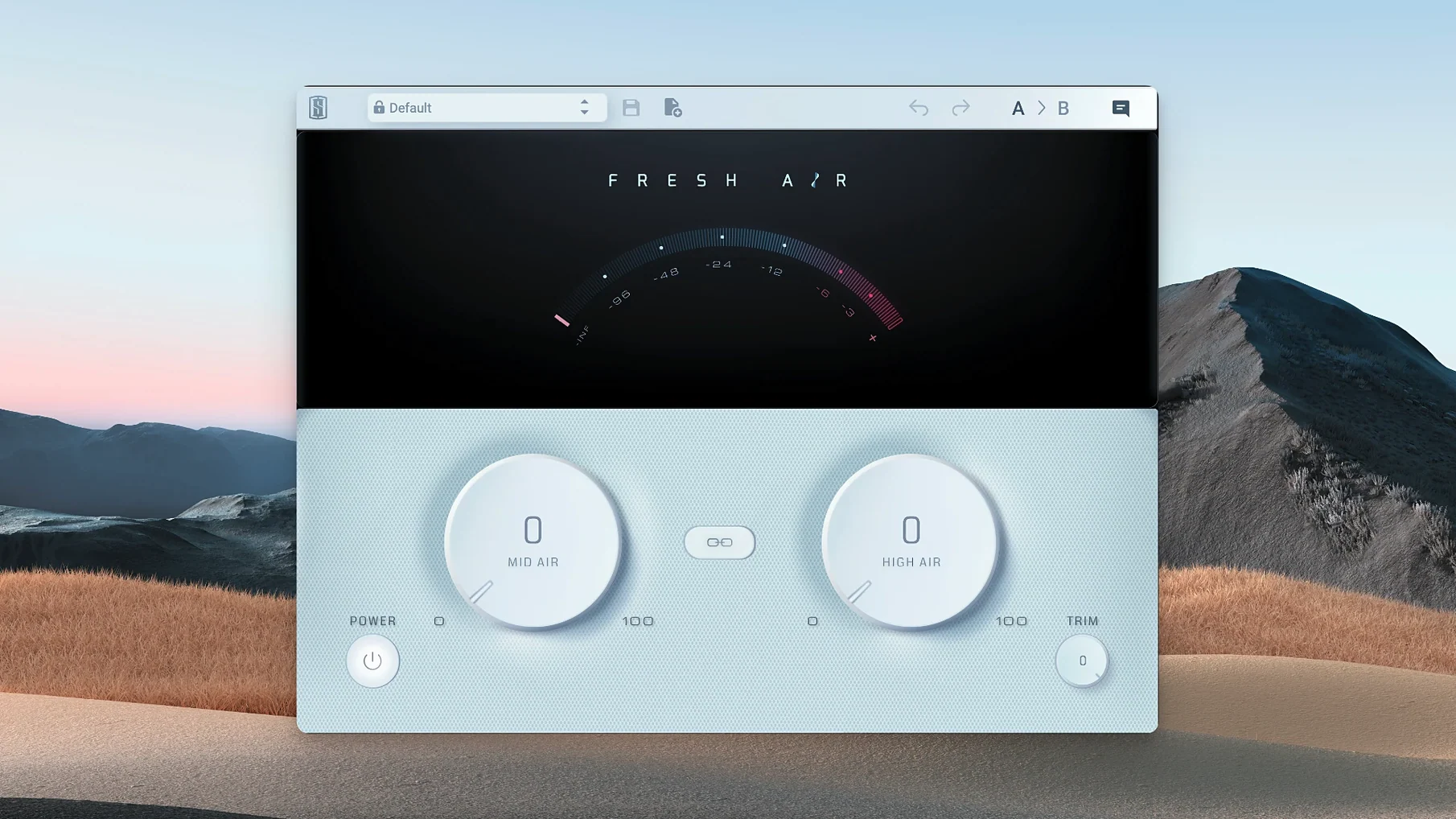
You likely already use an EQ to open up a dull vocal. Fresh Air works one step beyond that. Instead of boosting a static shelf, it uses dynamic processing modelled on classic exciter circuits to add presence that moves with the signal. It lives on a track insert or across a group bus, right where you would normally reach for a high-shelf boost but want more life and less bite.
The two main controls split the job. Mid Air lifts the presence range that pushes a vocal or snare forward in a busy mix. High Air reaches further up for genuine top-end shine. On a drum bus, a little High Air opens up the cymbals without making the hats stabby. On keys, it pulls a dull Rhodes out of the mud.
A Trim knob sits below, letting you match levels after the processing. Because the processing is not static, you get the lift without the fixed-phase artefacts of a standard EQ curve. That makes it a safer bet on sources where a naked high-shelf boost starts to sound brittle fast.
It runs on Apple Silicon Macs from macOS 11 onward. Worth reaching for when you need air that feels like part of the sound, not a layer of sizzle on top.
Maag Air Band is a static boost, this one moves with the signal
Fresh Air sits in a category that has a few familiar names. Here's where it fits.
Against Maag Audio EQ4 (the Air Band) — the Maag is a static boost, famously smooth but still just an EQ curve. If you push 20 kHz by 6 dB on a vocal, it stays there regardless of the performance. Fresh Air moves with the dynamics. On a whisper-to-belt vocal take, the Maag can feel like a fixed sheen; Fresh Air follows the envelope and thins out when the source gets quiet. Maag edges ahead if you want a known colour that's been on a thousand records. Fresh Air wins for transparency under level changes.
Compared to Aphex Vintage Aural Exciter emulations — the hardware exciter adds harmonic distortion as its main trick, which can thicken a thin recording beautifully but also introduces grit you can't fully remove. Fresh Air keeps the harmonic generation subtle and ties it to dynamics, so the processing doesn't build up a constant buzz. On a master bus, that matters. An Aphex-style exciter across a mix can glue things with its saturation; Fresh Air adds lift without changing the mix's weight.
Then there's iZotope Ozone's Exciter module. Ozone gives you multiband control and a choice of saturation modes — more surgical, more flexible. But the overhead is a larger window and more decisions. Fresh Air does one thing with two knobs. If you're dialling in a quick presence lift on twelve backing vocal tracks, the speed difference is real.
A tracking engineer's afternoon
A producer tracking a singer-songwriter has a session where the acoustic guitar and vocal were captured with a single ribbon mic. The raw take is warm but veiled — the ribbon rolls off early, and the whole performance sits behind a layer of wool. A high-shelf EQ at 10 kHz brings up string squeak and breath but also exposes the room's early reflections in an unflattering way.
Mid Air at about 11 o'clock pulls the vocal forward into the same space as the guitar transients without separating them into two disconnected layers. High Air goes up just enough to recover the shimmer on the guitar's top end that the ribbon missed, maybe 9 o'clock. The Trim brings the output back to unity. The result doesn't sound "processed" — it sounds like the mic suddenly heard what was in the room. That's the use case where Fresh Air earns its keep: not as an effect, but as a corrective that doesn't announce itself.
Link button ties Mid Air and High Air knobs together proportionally
- Link button — turning it on couples the Mid Air and High Air knobs. Adjust one and the other follows proportionally. Useful on a master bus when you want to lift the whole top end without shifting the balance between presence and air that you already dialled in on individual tracks.
- Trim before, not after — because the processing is dynamic, driving the input harder changes how the exciter reacts. If a source is quiet, push the Trim up into the plugin and pull the output level on the next insert instead. You get more grab from the dynamics without overloading the channel.
- Zero is not off — the knobs default to minimum, which is no processing. But the plugin still passes signal. You can leave it inserted and bypass it to A/B, or keep it active at zero and automate a boost for just the chorus section of a mix.
- Mono sources — Fresh Air works fine on mono tracks like a single snare close mic or a DI bass that needs a little finger noise definition. The processing doesn't widen the stereo field artificially, so it stays phase-safe on a mono-to-stereo bus.
Requirements
- macOS 11 or later
- Apple Silicon native
- Interface language: English
Comments 0
Sign in or create an account to leave a comment.
No comments yet…
If you’ve installed it, say how it went. Mention your Mac and macOS version — it helps the next person more than you’d think.
More in VST Plugins
All in VST Plugins-
 Slate Digital Murda Melodies
1.1.1
Apple Silicon
-
 Slate Digital Storch Filter
1.0.6
Apple Silicon
-
 Slate Digital Submerge
1.0.5
Apple Silicon
-
 ShaperBox
3.6.1
Apple Silicon
-
 Sonarworks SoundID Reference
5.12.0
Apple Silicon
-
 Serum
2.0.24
Apple Silicon
-
 Sonic Academy KICK
1.1.8
Apple Silicon
-
 Serato Sample
2.2.0
Apple Silicon